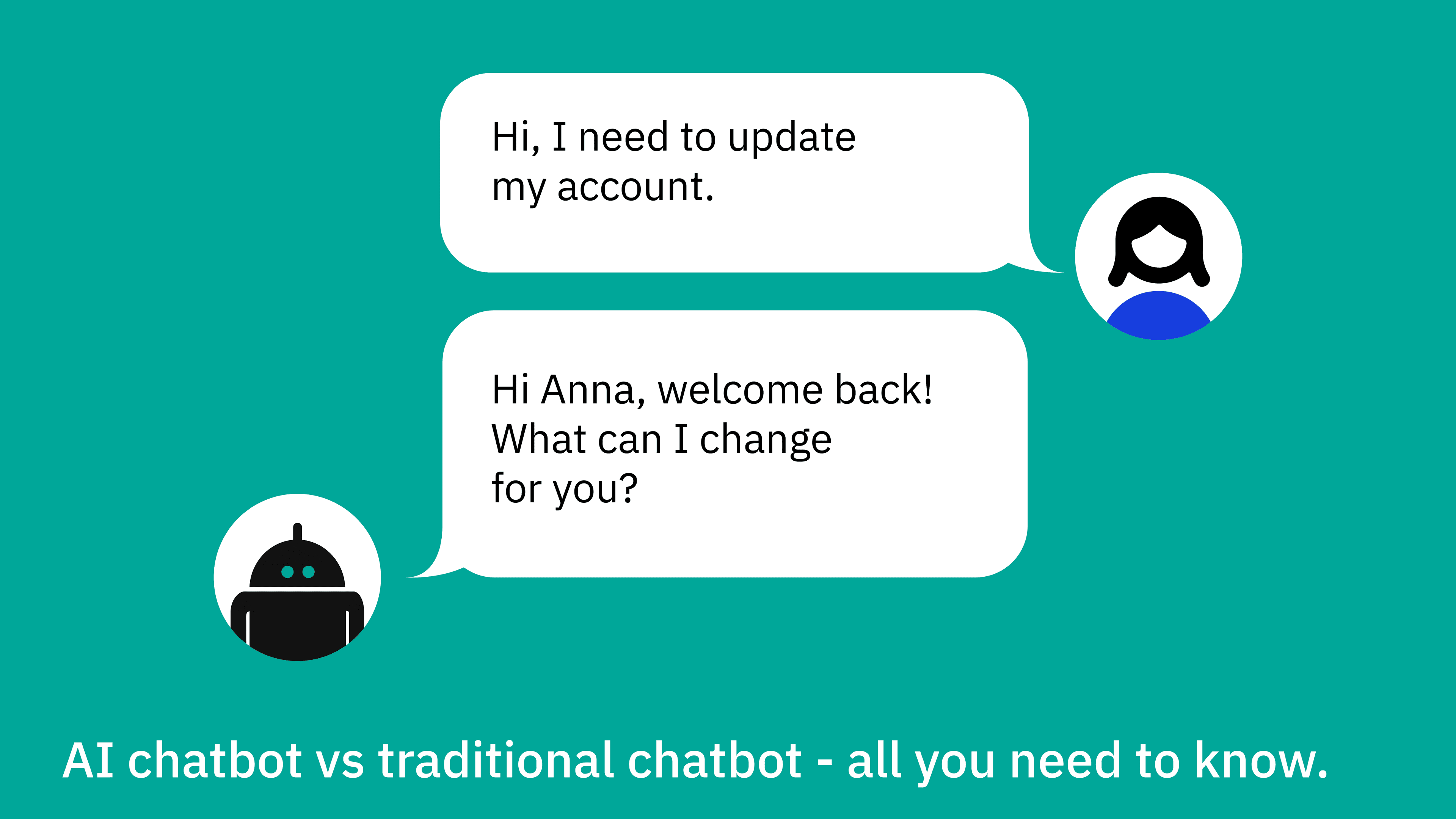
AI chatbot vs. traditional chatbot - all you need to know

Published on Thu May 15 2025
Updated on Fri Aug 08 2025
10 minute read
Think about the last time you wrote to a company’s customer service via a chat function. Did you speak to a human agent, or a computer program? Perhaps you’re not even sure, because the experience was so seamless and quick that it felt like talking to a particularly efficient and knowledgeable customer service representative. Chances are, they solved your issue within a couple of minutes or less, and you moved on without giving it a second thought.
And which should you think about for your business?
Taking this into account, one might deduce that for a fraction of the cost and with potentially greater results, a business could provide a stellar customer experience for its loyal consumers, even during times when you experience peaks. That’s been the goal of artificial intelligence programmers the world over for several years now, and the advances made in this field of technology have provided some of the most exciting opportunities for brands and their customer service teams in a long time. But what exactly is a chatbot, and how is an AI chatbot different? Is one better than the other? As you’ll see from our guide below, the answer, as it often is in life, is: it depends.
A history of virtual assistants.
How have these virtual assistants evolved to become such an integral part of our lives? Well, the first chatbots were created in the 1960s and were used to simulate a human conversation. MIT computer scientist Joseph Weizenbaum introduced the world to Eliza in 1966. She was a bot that used a pre-programmed script that simulated a psychotherapist’s conversation. The conversations that Eliza carried out were achieved through matching patterns and a substitution methodology that gave users the impression that she truly understood them. However, there was no actual ‘understanding’ on behalf of the program, and what began as an experiment to demonstrate the superficiality of communication between man and machine, ended up kickstarting a revolution in the field of computer-generated speech. As we can see, these early tools were not very effective - they couldn’t truly understand what the user was saying to them, and as a result, often produced nonsensical responses. In the 1990s, a new generation of technology was developed that was based on artificial intelligence. These chatbots were able to understand human language and respond in a more natural way. In modern times, these applications have evolved to become even more sophisticated. With the help of machine learning and natural language processing, they are now able to understand human emotions and provide a more customized experience. Some studies claim that an AI chatbot can produce 3,400% growth in operational savings in just over 4 years. But how is this possible, and in what ways do these digital friends help businesses create such a robust operational model? Let’s dive in.
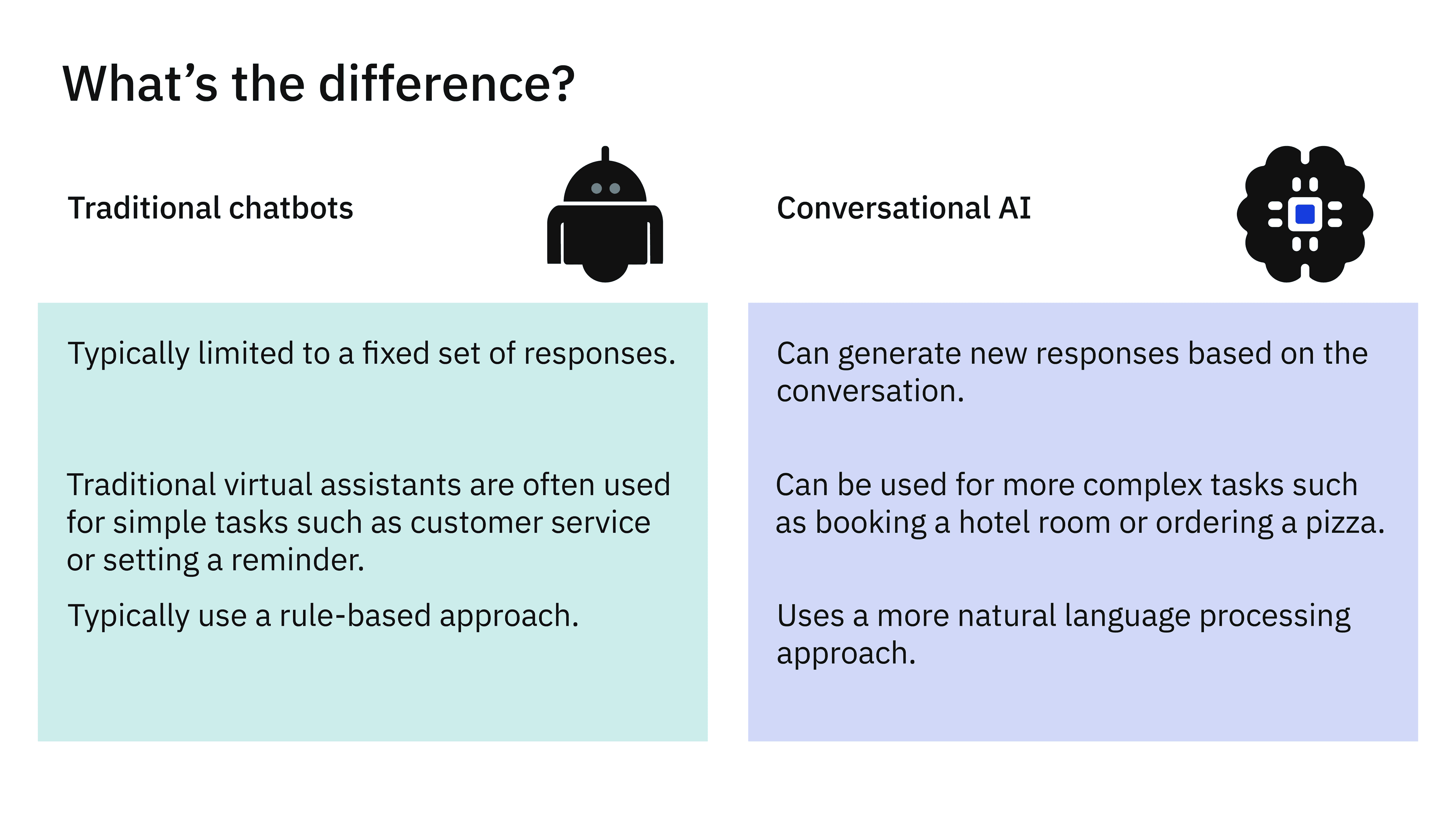
What’s the difference?
That’s a long story, and we’ll explore that in this article in a lot more detail - but in a nutshell: So, what's the bottom line? If you're looking for something to simply answer a few questions or provide customer service, then a chatbot is probably all you need. However, if you're looking for a more complex solution that can handle tasks such as booking a hotel room, ordering a pizza, upselling by recommending other products, updating customer personal information, etc, then you'll need a more advanced solution. But this is a strongly simplified view of quite a complex field, so let’s get into some juicy details.
What is a traditional chatbot?
First, some clarification. When we talk about this, we are referencing traditional bots that have been somewhat augmented by machine learning and other artificial intelligence capabilities, that they use to, for example, understand and respond to customer inquiries. They can provide a some level of accuracy and personalization, but they may also have difficulty understanding and responding to unusual or unexpected requests.
This is a slight upgrade on the rule-based solution, which may be based on ‘decision trees’ or other basic programming that allow them to respond to very specific queries with predetermined answers, or carry out simple administrative tasks. They operate with a basic level of NLP (natural language processing) in order to understand what the customer is saying and be able to respond.
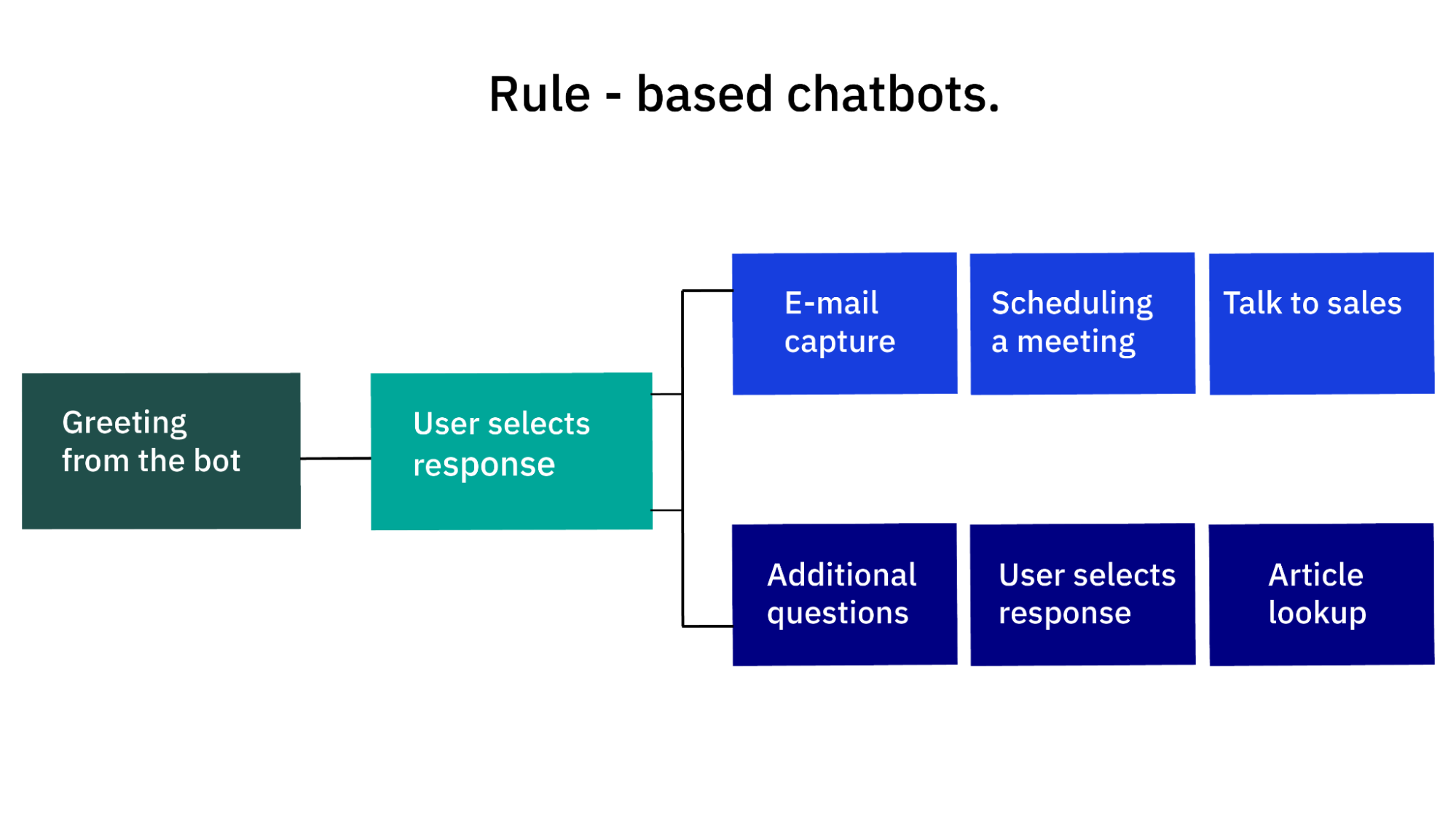
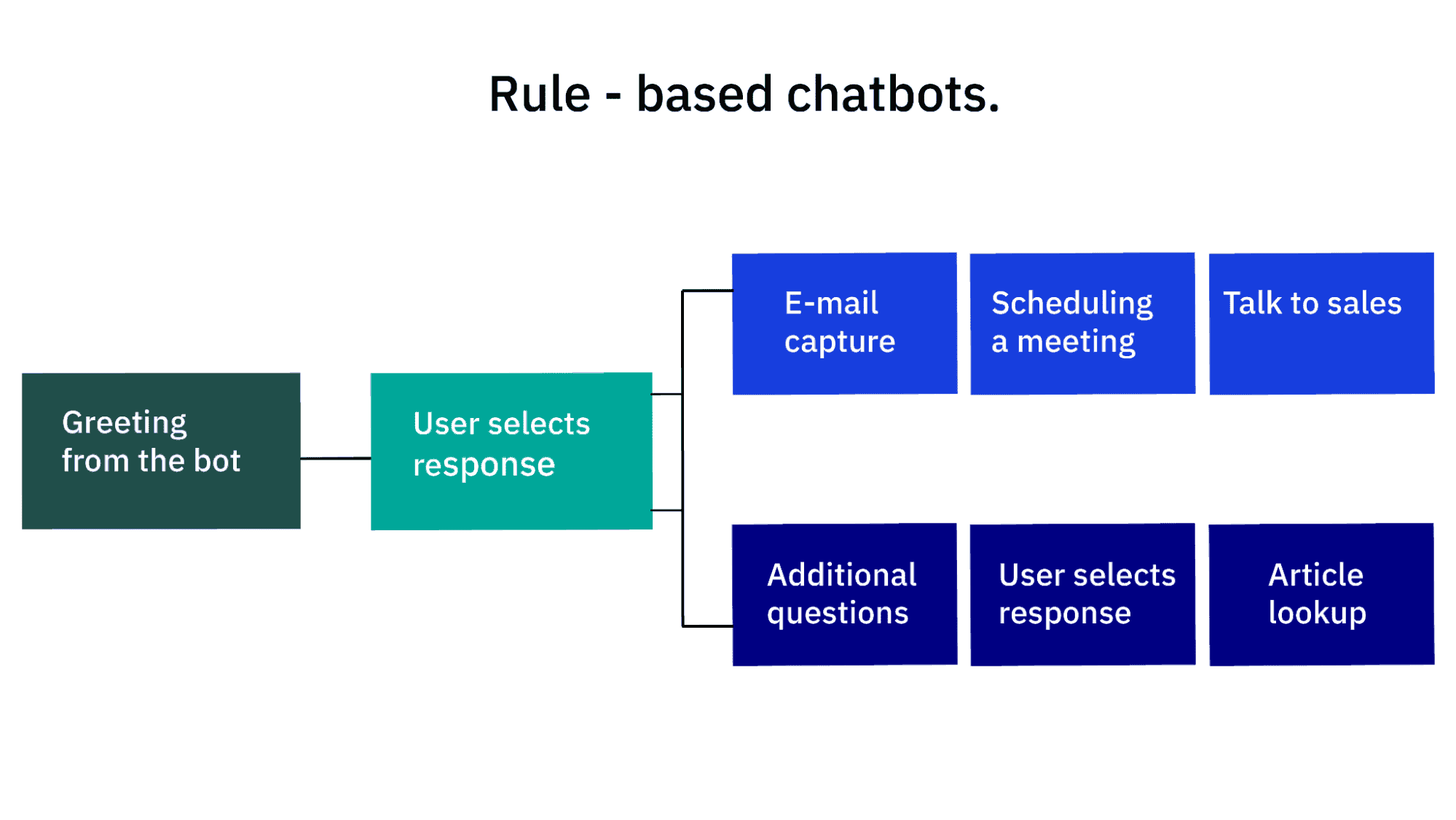
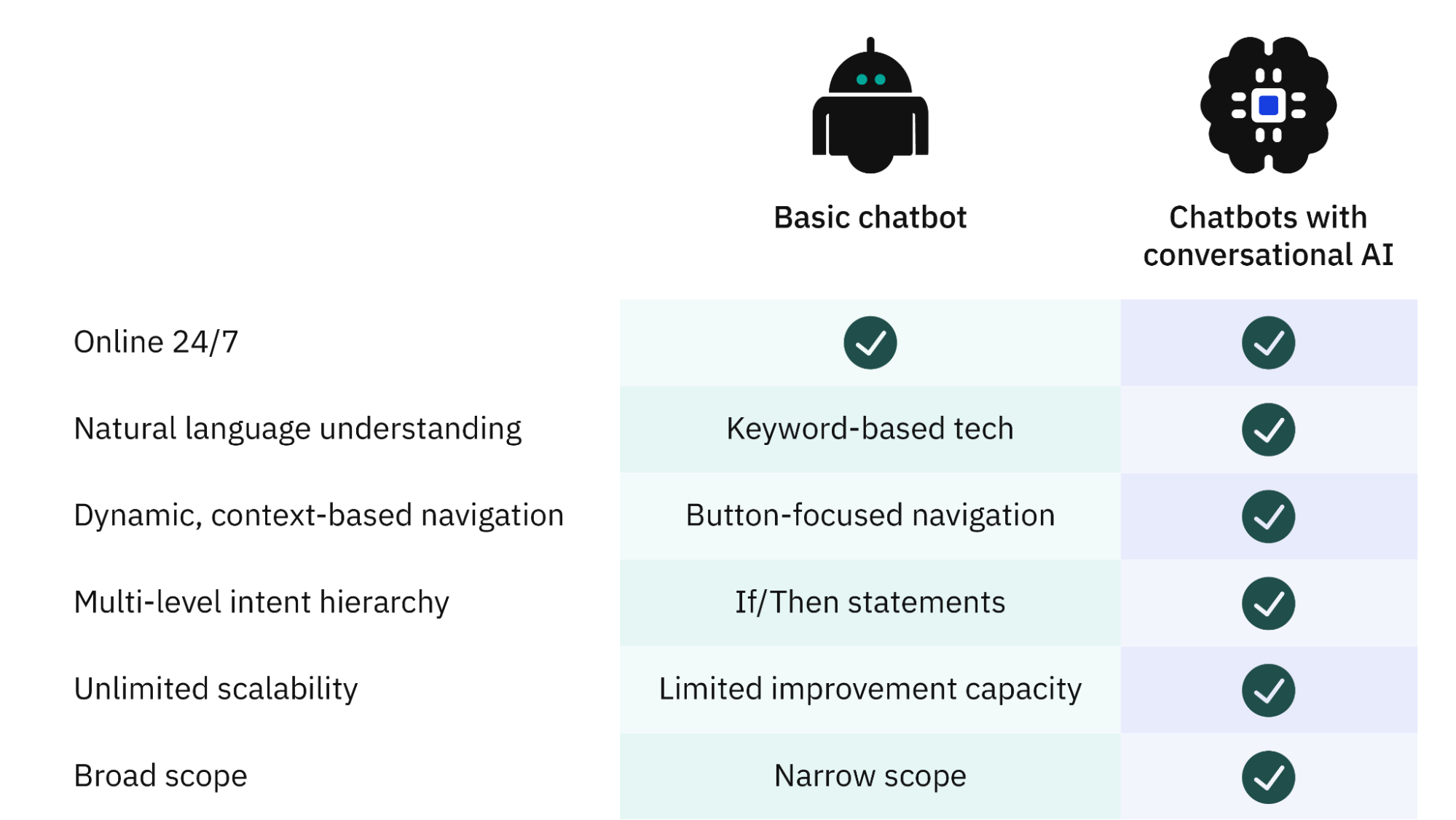
Traditional bots, or even bots that have been augmented with NLP or machine learning elements, carry certain benefits (and challenges) with them as well. You can see a summary of the key components and outcomes below.
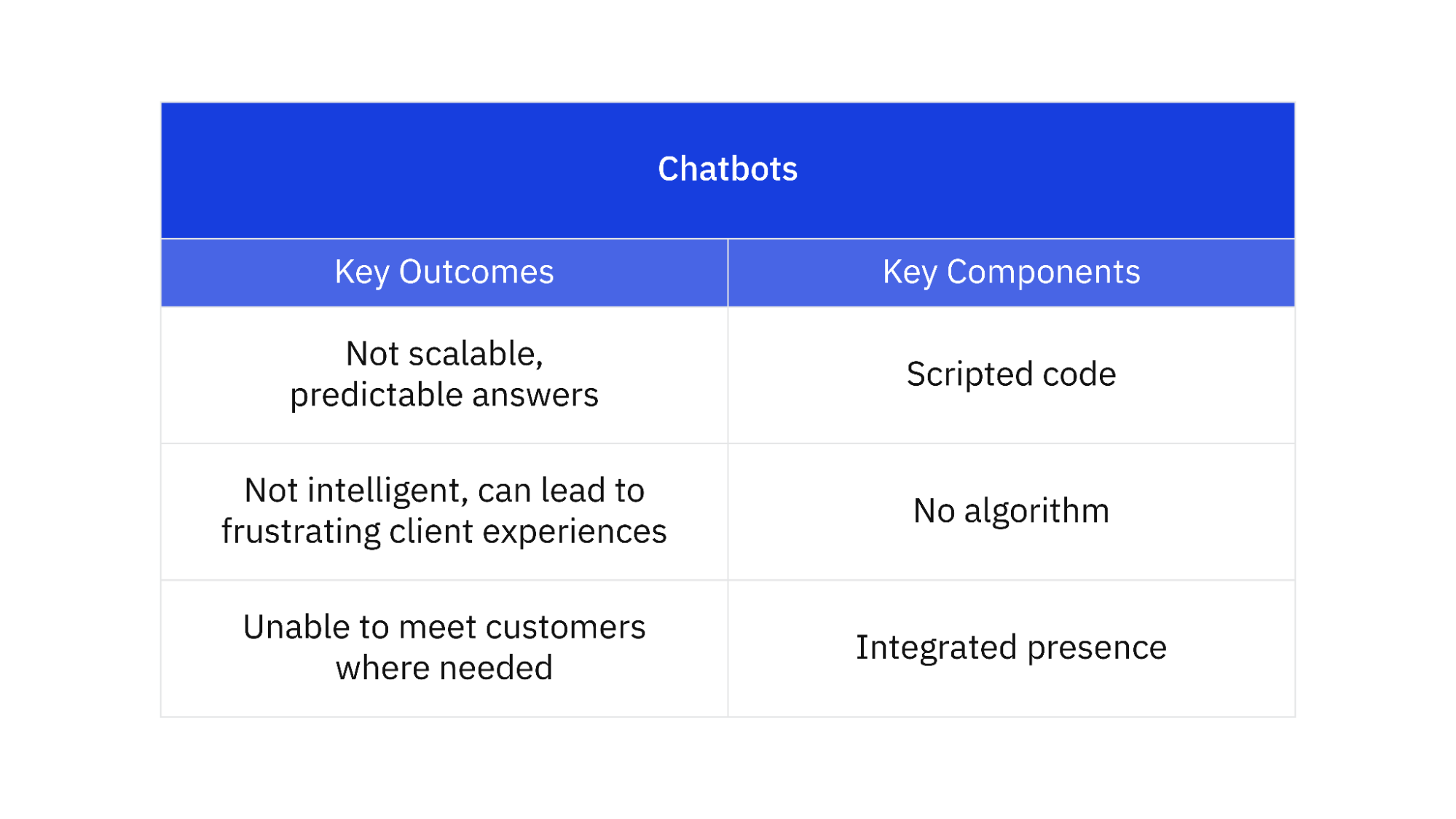
The benefits:
- Secure systems that are easier to safeguard.
- Easy and simple integration into legacy systems.
- Easier to integrate into an omnichannel approach and handover to a live agent.
- Personalizable in terms of media and other interactive elements.
- Much quicker to program and train.
- Smaller cost than conversational AI.
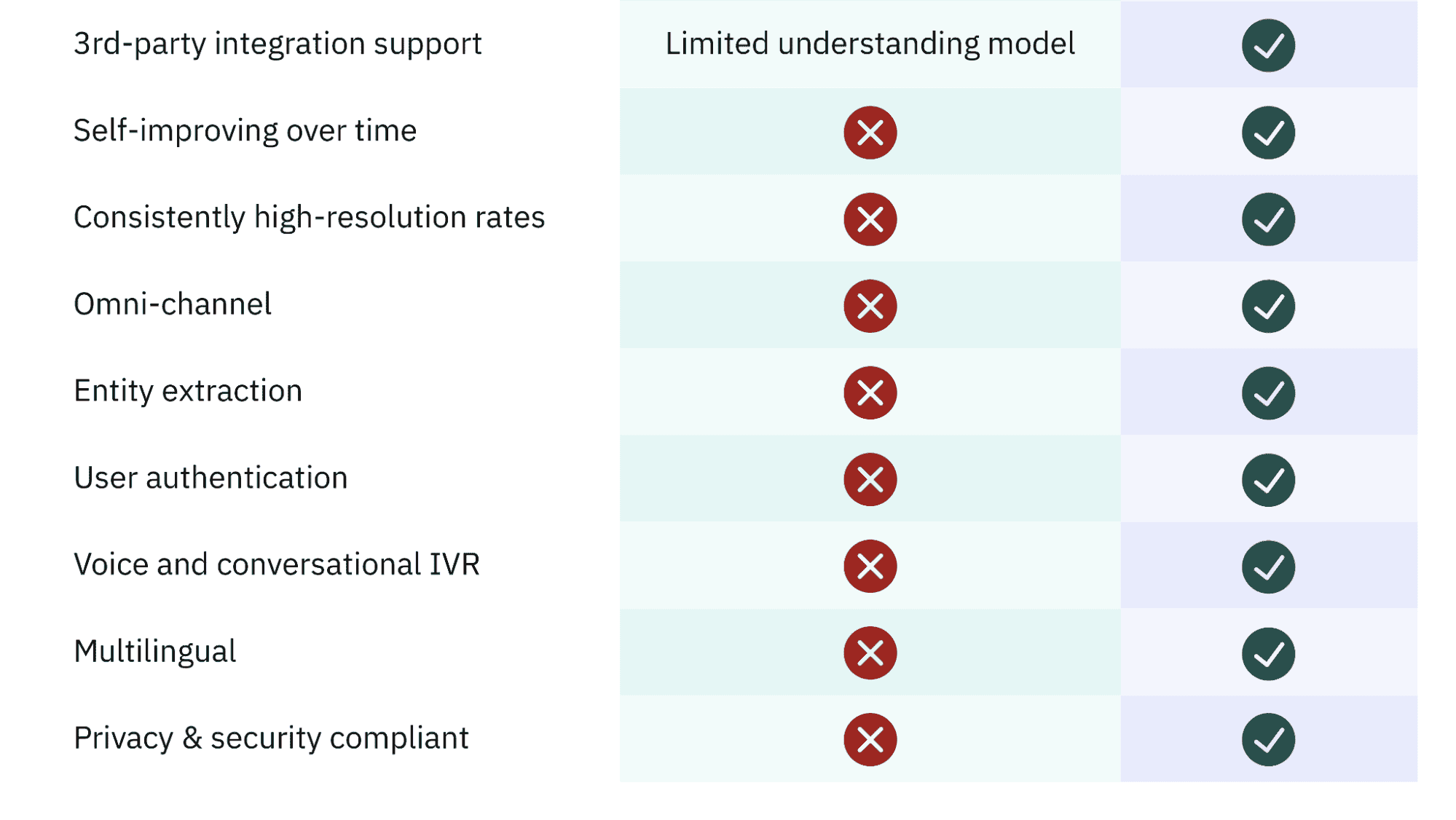
The challenges.
What is conversational AI?
Where a traditional chatbot is like an alarm clock that can be set to wake you up at a certain time, with a preselected ringtone, or even on a consistent schedule, an AI chatbot can be compared to a more advanced application that monitors your sleeping rhythms, can determine what phase of sleep you’re in, and thus wake you up at an optimal time. This analogy may be a bit of a stretch, but at the core is the same idea - the latter is a highly advanced version of the former, utilizing complex processes such as machine learning, NLP, NLU (natural language understanding), deep learning, and predictive analytics to deliver a truly unique and personalized experience for the user. Whilst the first option may seem like it accomplishes enough on its own - it can track orders and provide customers with answers, after all - a conversational AI adds a layer of complexity that can be a truly cost-effective alternative to agent-driven conversations. It can understand intent, context, and sentiment, and then use the platform to provide human-sounding replies that drive the interaction forward. You can take a look at some of the key components and outcomes of an AI chatbot below.
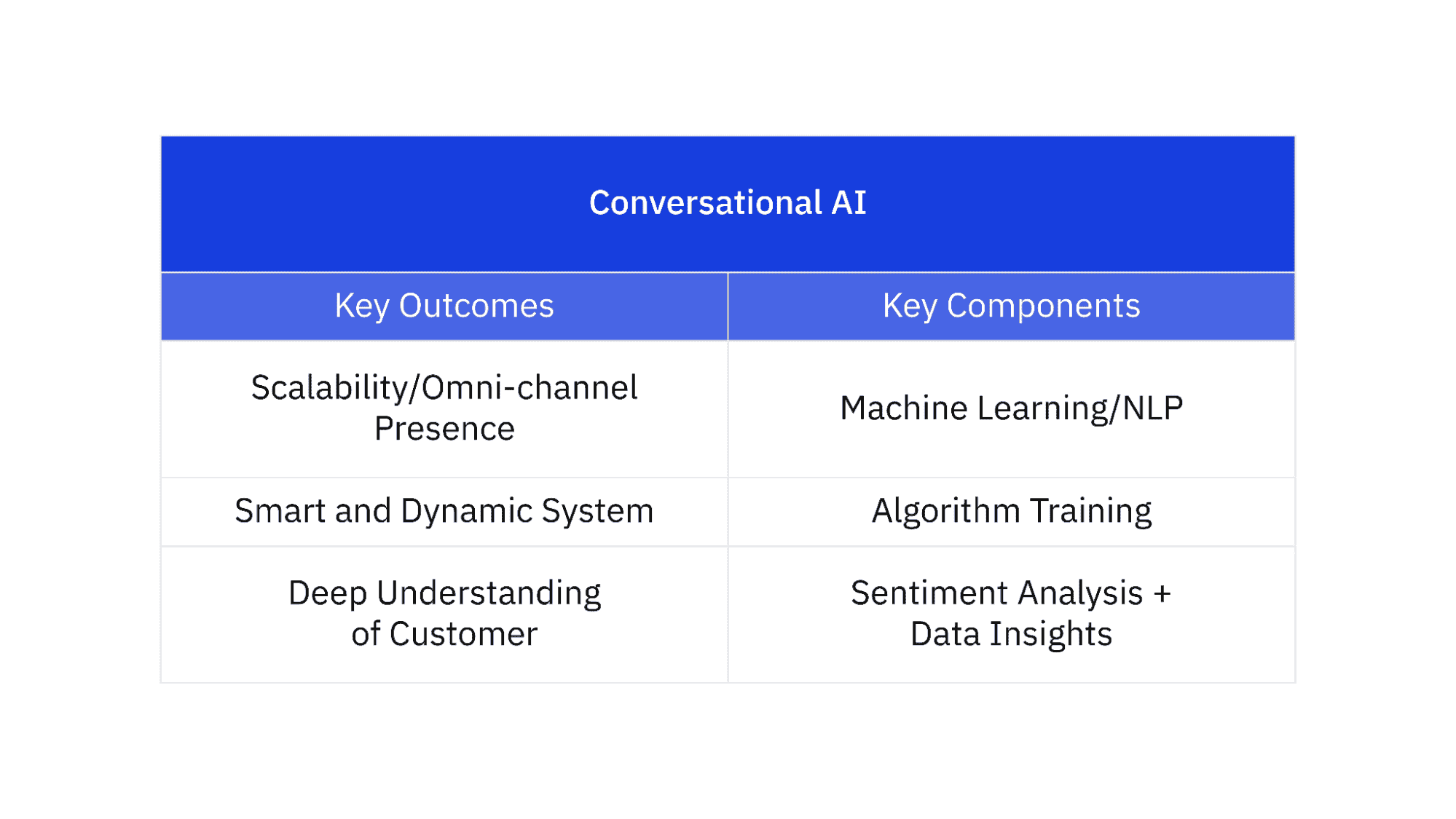
The benefits.
- The more data it collects, the more the program can continuously improve.
- Clearly understands patterns of behavior.
- Greater language recognition and possibility to implement a translation tool.
- Based on previous interactions and thanks to machine learning, it's able to make more decisions.
- More accurate in responses and able to recognise various types of requests.
How can brands leverage these tools, whichever they choose?
These digital powerhouses can be a valuable tool for businesses and organizations. Although the benefits are extensive, here are some of the main ones.
Improve customer service.
With conversational AI, businesses can provide a more natural and human-like customer service experience. This can lead to increased satisfaction and loyalty from customers, as well as a more personalized experience that will have users coming back for more.
Automating tasks.
Tasks that are relatively simple for a customer, but may cause additional time spent on administrative queries for human regents, can be easily automated with this technology. Booking a hotel room, ordering a taxi, checking an order status, or even payment reminders for bills can all be done by a bot, freeing up employee time to focus on more complex tasks.
Lead generation.
By engaging in conversations with potential customers, an AI chatbot can check purchase histories, preferences, and other data, to provide a more customized experience for the user. If you’re buying a wooly hat for winter, a bot may notice that you also purchased scarves in the past and share a friendly recommendation for a matching set.
Research.
Because it spends so much time engaging in conversation with users, this conversational tool can gather more data and help a business gain insights into their customer base. This allows you to make better-informed decisions and market products or services specifically to loyal fanbases, or based on purchasing patterns.
So what’s better for your business?
The answer to this question depends on a variety of factors, including your business goals, budget, and resources. It may be that you’re looking for something quick and easy, cheaper to implement, or you simply don’t have the means to develop something more complex. Conversely, your business could be looking for new opportunities to develop its CX operations with a smart new tool. If you're looking for a quick and easy solution that doesn't require a lot of data or training, then a traditional chatbot may be the right choice for you. However, if you're looking for a more sophisticated solution that can provide a more natural and human-like conversation, then an AI chatbot may be a better option. At the end of the day, the best advice will come from an experienced partner who understands the needs of your business and which option will benefit you the most, while keeping costs down. At Transcom, our CX Advisory team is able to survey your entire customer journey and match your goals with what you’re working with. They can then recommend which solution is right for you based on that assessment.
Are there alternatives to these choices?
As with anything - of course! There are always alternatives you can consider, especially if you’re looking for a solution to help you prepare for peaks or unexpected scenarios. These include:
- Human agents. The most common and in many cases, the most reliable form of providing excellent customer service to your consumers. Human agents provide a personalized experience like no other. Yet, in some markets or specific use cases, it may be difficult to find individuals with the right experience or linguistic skills. Augmenting the work of human agents with digital tools provides you with more flexibility and reduces the risk of stress or burnout.
- IVR. A well-balanced customer service operation usually includes IVR technology, which can automate very simple tasks that might usually go to human agents. However, again, this tool is limited in its scope and ability to recognize more complex requests, making a human agent or a conversational AI indispensable.
- Knowledge base. Having an extensive knowledge base is a great and cost-effective option to keep your customers in-the-know on products and services, how to resolve simple issues, and company news. These solutions, however, are not always the first port of call for a customer looking to be helped, and may not provide the answer to a technical issue or that personal touch which lets a user feel they are being taken care of.
Read more
Created at Thu Apr 02 2026
3 min read
Leading Voices: how CIO Sandra Kujundzic’s teams tame AI volatility and drive real value.
AI is accelerating faster than enterprise operating models were designed to handle. In every organization, transformation is underway. Roadmaps are expanding, budgets are shifting, and expectations from boards and customers are rising. But acceleration without structure creates volatility - and customer experience is no exception to the rule. While technology introduces possibility, leadership determines whether that possibility becomes measurable value or a mere disruption.
Navigating this ten