What is lifelong learning and its benefits?

Published on Thu May 15 2025
Updated on Fri Aug 08 2025
10 minute read
One of the most important traits human beings possess is our innate sense of curiosity. It’s what drives us through life from our first steps. Unfortunately, for some, that curiosity ends quickly and abruptly after the end of education or soon thereafter. At Transcom, we believe that curiosity and the drive to learn are crucial. In fact, it is so important to us that we made it one of our core values: “We’re lifelong learners.” Today, we’ll talk about why it’s necessary to nurture that curiosity through lifelong learning by exploring what it is, why it’s important, giving you some examples, and talking about the benefits of lifelong learning.
What is lifelong learning?
While it doesn’t have a strict definition, one thing that all definitions of lifelong learning have in common is that it’s motivated by curiosity and personal fulfillment. The rest of it is up to the person themselves. It can be formal or informal, depending on the type of education you prefer or are available to receive, but it has to be self-motivated. This, of course, doesn’t mean that lifelong learning has to only have personal fulfillment and growth as an end goal. As an added goal you can have business advancement, upskilling, promotions, getting hired somewhere, etc.
Why is lifelong learning important?
Apart from the benefits listed below, it is important to keep one’s curiosity and to keep trying to go out of your comfort zone to find new experiences. With access to the internet and the vast amounts of information available, it is easier than ever to find materials and learn something new. Also, we all need something to fulfill us on a personal level. Self-realization. It can come in many different forms, but what’s important is to never be satisfied and to always keep searching and learning.
Benefits of lifelong learning.
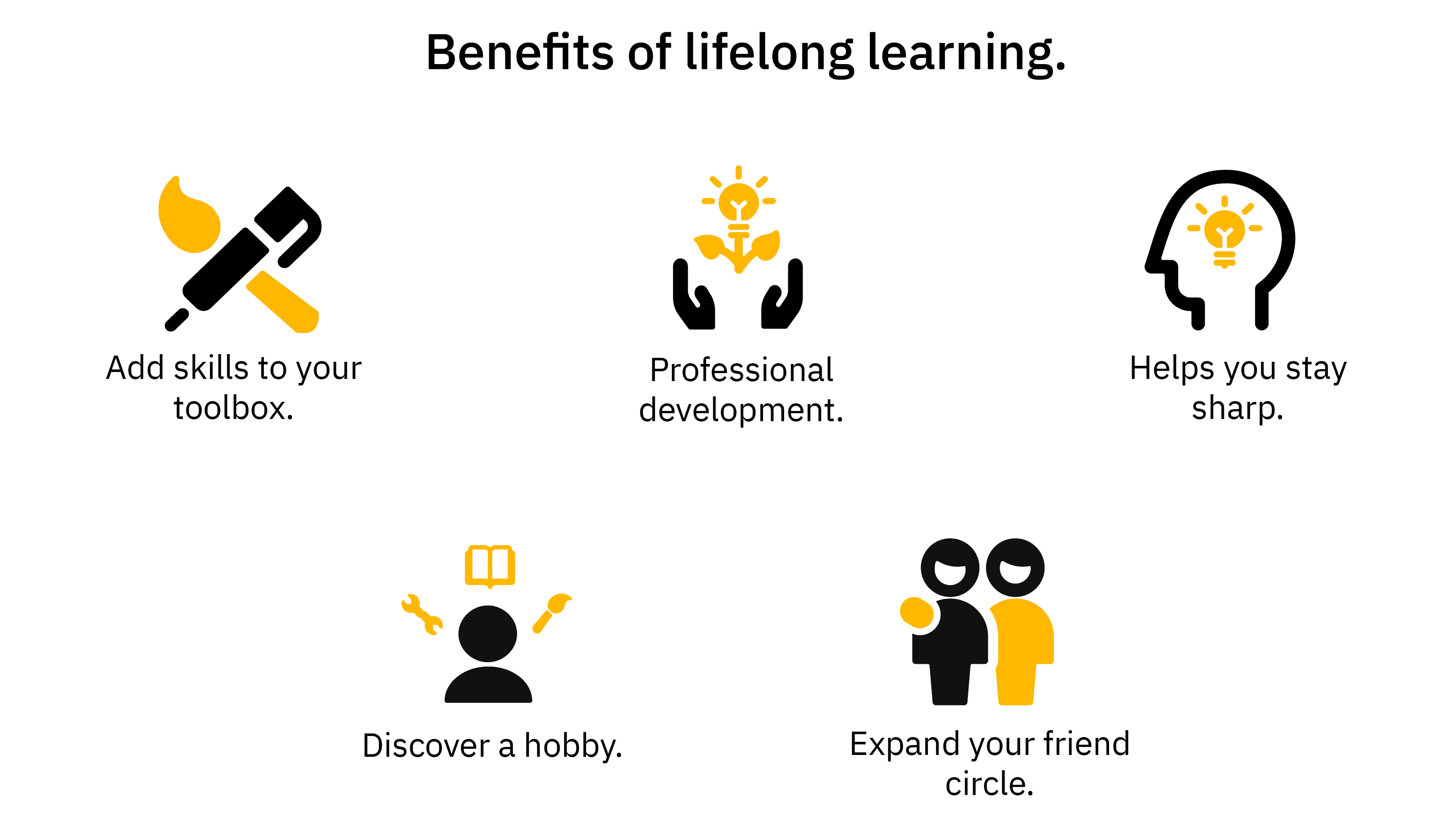
There are a vast number of benefits of lifelong learning. We’ll cover 5 main or more general ones in order to give you an overview of what it can do for you. Others can be viewed as falling under these 5 or can be seen as more fringe benefits. So, what exactly are the benefits of lifelong learning?
-
Add skills to your toolbox
-
Professional development
-
Helps you stay sharp
Examples of lifelong learning.
As we said previously, lifelong learning is easier than ever. With the internet offering an unimaginable amount of information on nearly every topic, accompanied by courses and video lessons there’s little to no excuse not to start your lifelong learning journey today. One of the ways you can do that is to intentionally focus on what you’re weakest at. This takes you out of your comfort zone but also provides the best base for learning because you should progress the fastest. In turn, this will give you a sense of accomplishment and motivation to continue learning. Another option is to slot the learning into your daily schedule. Not necessarily by explicitly making time for it because that then bites into your free time, but combine learning with other activities. If you’re learning a language, and like watching films or TV, combine them by watching films in the target language. By watching films and TV in that way, you are getting exposed to the language, its structure, vocabulary, and especially pronunciation. If you’re the more organized and structured type, you can always take part in classes or lessons. There’s nothing saying that lifelong learning cannot be organized or based on institutions. Lastly, lifelong learning can be a project in and of itself. Jumping off the deep end and figuring out how things work through tinkering and deconstructing, literally or figuratively, is a great way to learn. It does take the most time, but that way you get a deeper understanding of how something works. Be it processes, systems, tools, or machinery, the route is the same.
Read more
Created at Fri Mar 27 2026
5 min read
Leading Voices: how Fabletics’ Jam Barton wins respect, encourages engagement, and leads unstoppable teams.
Leaders’ most valuable insights don’t come from their titles. They come from lessons learnt along real professional journeys. That’s the wisdom behind our Leading Voices series charting the careers and challenges of the real pioneers behind the future of customer experience. And there couldn’t be a richer example than the story of Julie ‘Jam’ Barton. With more than 16 years of experience across both client and BPO environments, she now leads global training and communications for member servic